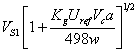
VS1=the 1-g stalling speed based on CNAmax with the flaps retracted at the particular weight under consideration;
w=average wing loading (pounds per square foot) at the particular weight under consideration.

(2) At altitudes where VC is limited by Mach number --
(i) VB may be chosen to provide an optimum margin between low and high speed buffet boundaries; and,
(ii) VB need not be greater than VC.
(e) Design flap speeds, VF. For VF, the following apply:
(1) The design flap speed for each flap position (established in accordance with §25.697(a)) must be sufficiently greater than the operating speed recommended for the corresponding stage of flight (including balked landings) to allow for probable variations in control of airspeed and for transition from one flap position to another.
(2) If an automatic flap positioning or load limiting device is used, the speeds and corresponding flap positions programmed or allowed by the device may be used.
(3) VF may not be less than --
(i) 1.6 VS1 with the flaps in takeoff position at maximum takeoff weight;
(ii) 1.8 VS1 with the flaps in approach position at maximum landing weight, and
(iii) 1.8 VS0 with the flaps in landing position at maximum landing weight.
(f) Design drag device speeds, VDD. The selected design speed for each drag device must be sufficiently greater than the speed recommended for the operation of the device to allow for probable variations in speed control. For drag devices intended for use in high speed descents, VDD may not be less than VD. When an automatic drag device positioning or load limiting means is used, the speeds and corresponding drag device positions programmed or allowed by the automatic means must be used for design.
[Doc. No. 5066, 29 FR 18291, Dec. 24, 1964, as amended by Amdt. 25-23, 35 FR 5672, Apr. 8, 1970; Amdt. 25-86, 61 FR 5220, Feb. 9, 1996; Amdt. 25-91, 62 FR 40704, July 29, 1997]
![[FAR Part § 25.335: Design airspeeds -- FAA FARS, 14 CFR] -- Flightsim Aviation Zone - Number 1 Flight Simulation and Aviation Resource! Information, Tools, Downloads, Databases, FAQ, Aviation Humour, Glossaries, Directory, FS2006, Multimedia, Screenshots, Free Flight Planner, Weather Reports](/images/gui/header_logo.gif)




 add
to favorites
add
to favorites Link
to this!
Link
to this!