(ii) The force resulting from the wet runway braking coefficient of friction determined in accordance with paragraphs (c) or (d) of this section, as applicable, taking into account the distribution of the normal load between braked and unbraked wheels at the most adverse center-of-gravity position approved for takeoff.
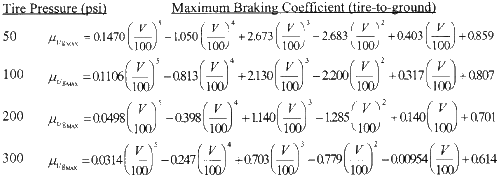
(c) The wet runway braking coefficient of friction for a smooth wet runway is defined as a curve of friction coefficient versus ground speed and must be computed as follows:
(1) The maximum tire-to-ground wet runway braking coefficient of friction is defined as:

Linear interpolation may be used for tire pressures other than those listed.
(2) The maximum tire-to-ground wet runway braking coefficient of friction must be adjusted to take into account the efficiency of the anti-skid system on a wet runway. Anti-skid system operation must be demonstrated by flight testing on a smooth wet runway, and its efficiency must be determined. Unless a specific anti-skid system efficiency is determined from a quantitative analysis of the flight testing on a smooth wet runway, the maximum tire-to-ground wet runway braking coefficient of friction determined in paragraph (c)(1) of this section must be multiplied by the efficiency value associated with the type of anti-skid system installed on the airplane:
-------------------------------------------------------
Efficiency
Type of anti-skid system             value
-------------------------------------------------------
On-Off....................................  0.30
Quasi-Modulating..........................  0.50
Fully Modulating..........................  0.80
-------------------------------------------------------
(d) At the option of the applicant, a higher wet runway braking coefficient of friction may be used for runway surfaces that have been grooved or treated with a porous friction course material. For grooved and porous friction course runways, the wet runway braking coefficent of friction is defined as either:
(1) 70 percent of the dry runway braking coefficient of friction used to determine the dry runway accelerate-stop distance; or
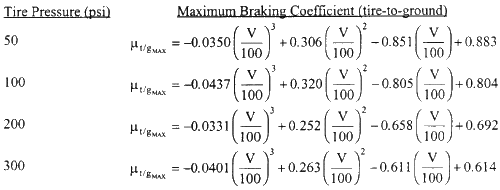
(2) The wet runway braking coefficient defined in paragraph (c) of this section, except that a specific anti-skid system efficiency, if determined, is appropriate for a grooved or porous friction course wet runway, and the maximum tire-to-ground wet runway braking coefficient of friction is defined as:
Where --
Tire Pressure=maximum airplane operating tire pressure (psi);
μt/gMAX=maximum tire-to-ground braking coefficient;
V=airplane true ground speed (knots); and
Linear interpolation may be used for tire pressures other than those listed.
(e) Except as provided in paragraph (f)(1) of this section, means other than wheel brakes may be used to determine the accelerate-stop distance if that means --
(1) Is safe and reliable;
(2) Is used so that consistent results can be expected under normal operating conditions; and
(3) Is such that exceptional skill is not required to control the airplane.
(f) The effects of available reverse thrust --
(1) Shall not be included as an additional means of deceleration when determining the accelerate-stop distance on a dry runway; and
(2) May be included as an additional means of deceleration using recommended reverse thrust procedures when determining the accelerate-stop distance on a wet runway, provided the requirements of paragraph (e) of this section are met.
(g) The landing gear must remain extended throughout the accelerate-stop distance.
(h) If the accelerate-stop distance includes a stopway with surface characteristics substantially different from those of the runway, the takeoff data must include operational correction factors for the accelerate-stop distance. The correction factors must account for the particular surface characteristics of the stopway and the variations in these characteristics with seasonal weather conditions (such as temperature, rain, snow, and ice) within the established operational limits.
(i) A flight test demonstration of the maximum brake kinetic energy accelerate-stop distance must be conducted with not more than 10 percent of the allowable brake wear range remaining on each of the airplane wheel brakes.
[Doc. No. 5066, 29 FR 18291, Dec. 24, 1964, as amended by Amdt. 25-42, 43 FR 2321, Jan. 16, 1978; Amdt. 25-92, 63 FR 8318, Feb. 18, 1998]
![[FAR Part § 25.109: Accelerate-stop distance -- FAA FARS, 14 CFR] -- Flightsim Aviation Zone - Number 1 Flight Simulation and Aviation Resource! Information, Tools, Downloads, Databases, FAQ, Aviation Humour, Glossaries, Directory, FS2006, Multimedia, Screenshots, Free Flight Planner, Weather Reports](/images/gui/header_logo.gif)




 add
to favorites
add
to favorites Link
to this!
Link
to this!