(2) The attachment between the seat/restraint system and the test fixture must remain intact, although the seat structure may have deformed.
(3) Each shoulder harness strap must remain on the ATD's shoulder during the impact.
(4) The safety belt must remain on the ATD's pelvis during the impact.
(5) The results of the dynamic tests must show that the occupant is protected from serious head injury.
(i) When contact with adjacent seats, structure, or other items in the cabin can occur, protection must be provided so that the head impact does not exceed a head injury criteria (HIC) of 1,000.
t1 is the initial integration time, expressed in seconds, t2 is the final integration time, expressed in seconds, (t2− t1) is the time duration of the major head impact, expressed in seconds, and a(t) is the resultant deceleration at the center of gravity of the head form expressed as a multiple of g (units of gravity).

(iii) Compliance with the HIC limit must be demonstrated by measuring the head impact during dynamic testing as prescribed in paragraphs (b)(1) and (b)(2) of this section or by a separate showing of compliance with the head injury criteria using test or analysis procedures.
(6) Loads in individual shoulder harness straps may not exceed 1,750 pounds. If dual straps are used for retaining the upper torso, the total strap loads may not exceed 2,000 pounds.
(7) The compression load measured between the pelvis and the lumbar spine of the ATD may not exceed 1,500 pounds.
(d) For all single-engine airplanes with a VSO of more than 61 knots at maximum weight, and those multiengine airplanes of 6,000 pounds or less maximum weight with a VSO of more than 61 knots at maximum weight that do not comply with §23.67(a)(1);
(1) The ultimate load factors of §23.561(b) must be increased by multiplying the load factors by the square of the ratio of the increased stall speed to 61 knots. The increased ultimate load factors need not exceed the values reached at a VS0 of 79 knots. The upward ultimate load factor for acrobatic category airplanes need not exceed 5.0g.
(2) The seat/restraint system test required by paragraph (b)(1) of this section must be conducted in accordance with the following criteria:
(i) The change in velocity may not be less than 31 feet per second.
(ii)(A) The peak deceleration (gp) of 19g and 15g must be increased and multiplied by the square of the ratio of the increased stall speed to 61 knots:
gp=19.0 (VS0/61) 2 or gp=15.0 (VS0/61) 2
(B) The peak deceleration need not exceed the value reached at a VS0 of 79 knots.
(iii) The peak deceleration must occur in not more than time (tr), which must be computed as follows:
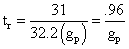
where --
gp=The peak deceleration calculated in accordance with paragraph (d)(2)(ii) of this section
tr=The rise time (in seconds) to the peak deceleration.
(e) An alternate approach that achieves an equivalent, or greater, level of occupant protection to that required by this section may be used if substantiated on a rational basis.
[Amdt. 23-36, 53 FR 30812, Aug. 15, 1988, as amended by Amdt. 23-44, 58 FR 38639, July 19, 1993; Amdt. 23-50, 61 FR 5192, Feb. 9, 1996]
![[FAR Part § 23.562: Emergency landing dynamic conditions -- FAA FARS, 14 CFR] -- Flightsim Aviation Zone - Number 1 Flight Simulation and Aviation Resource! Information, Tools, Downloads, Databases, FAQ, Aviation Humour, Glossaries, Directory, FS2006, Multimedia, Screenshots, Free Flight Planner, Weather Reports](/images/gui/header_logo.gif)


![HIC = { (t2-t1)[1/(t2-t1) (t2-integral-t1)a(t)dt]^2.5] }](/data_img/FARS/23.562_1.gif)


 add
to favorites
add
to favorites Link
to this!
Link
to this!